Pages

Showing posts with label Dogs. Show all posts

Tuesday, August 26, 2025

Homemade Dog Biscuits: National Dog Day!


Today is National Dog Day, so in celebration I'm posting a recipe for Homemade Dog Biscuits. This particular recipe is also good for fighting plaque build up. And, needless to say there is no chocolate in these biscuits. Chocolate is dangerous for dogs, often life-threatening.

HOMEMADE DOG BISCUITS

Ingredients
3/4 cup powdered skim milk
1/2 cup stone ground cornmeal
1/4 cup bulghur wheat
1-1/4 cups whole wheat flour
1 chicken bouillon cube
1-12/ cups boiling water
1 cup quick cooking rolled oats
1 egg, beaten

Directions
In mixing bowl, combine powdered skim milk, cornmeal, bulghur wheat, and flour. Set aside
In large mixing bowl, dissolve bouillon cube in boiling water. Add rolled oats and let stad about 5 minutes. Stir in beaten egg.
Slowly stir in dry ingredients, half cup at a time, until well blended. Blend last few cups with hands.
Divide dough into 2 balls.
Knead each dough ball on floured surface (5 minutes)
With rolling pin, roll dough between 1/4" to 1/2" thickness
Cut with Bone shaped Biscuit Cutter (or another cookie cutter) and put on baking sheet lined with foil.
Bake 50 minutes at 325.
Turn of oven and let biscuits cool for several hours or overnight, in the oven.
Store at room temperature in container with lose-fitting lid. 


Monday, August 26, 2024

HOMEMADE DOG BISCUITS: National Dog Day!


Today is National Dog Day, so in celebration I'm posting a recipe for Homemade Dog Biscuits. This particular recipe is also good for fighting plaque build up. And, needless to say there is no chocolate in these biscuits. Chocolate is dangerous for dogs, often life-threatening.

HOMEMADE DOG BISCUITS

Ingredients
3/4 cup powdered skim milk
1/2 cup stone ground cornmeal
1/4 cup bulghur wheat
1-1/4 cups whole wheat flour
1 chicken bouillon cube
1-12/ cups boiling water
1 cup quick cooking rolled oats
1 egg, beaten

Directions
In mixing bowl, combine powdered skim milk, cornmeal, bulghur wheat, and flour. Set aside
In large mixing bowl, dissolve bouillon cube in boiling water. Add rolled oats and let stad about 5 minutes. Stir in beaten egg.
Slowly stir in dry ingredients, half cup at a time, until well blended. Blend last few cups with hands.
Divide dough into 2 balls.
Knead each dough ball on floured surface (5 minutes)
With rolling pin, roll dough between 1/4" to 1/2" thickness
Cut with Bone shaped Biscuit Cutter (or another cookie cutter) and put on baking sheet lined with foil.
Bake 50 minutes at 325.
Turn of oven and let biscuits cool for several hours or overnight, in the oven.
Store at room temperature in container with lose-fitting lid. 


Saturday, February 24, 2024

HOMEMADE DOG BISCUITS: National Dog Biscuit Day!


Yesterday was National Dog Biscuit Day. It's never too late to celebrate. Here's a recipe for Homemade Dog Biscuits. This particular recipe is also good for fighting plaque build up. And, needless to say there is no chocolate in these biscuits. Chocolate is dangerous for dogs, often life-threatening.

HOMEMADE DOG BISCUITS

Ingredients
3/4 cup powdered skim milk
1/2 cup stone ground cornmeal
1/4 cup bulghur wheat
1-1/4 cups whole wheat flour
1 chicken bouillon cube
1-12/ cups boiling water
1 cup quick cooking rolled oats
1 egg, beaten

Directions
In mixing bowl, combine powdered skim milk, cornmeal, bulghur wheat, and flour. Set aside
In large mixing bowl, dissolve bouillon cube in boiling water. Add rolled oats and let stad about 5 minutes. Stir in beaten egg.
Slowly stir in dry ingredients, half cup at a time, until well blended. Blend last few cups with hands.
Divide dough into 2 balls.
Knead each dough ball on floured surface (5 minutes)
With rolling pin, roll dough between 1/4" to 1/2" thickness
Cut with Bone shaped Biscuit Cutter (or another cookie cutter) and put on baking sheet lined with foil.
Bake 50 minutes at 325.
Turn of oven and let biscuits cool for several hours or overnight, in the oven.
Store at room temperature in container with lose-fitting lid. 


Saturday, August 26, 2023

HOMEMADE DOG BISCUITS: National Dog Day!


Today is National Dog Day, so in celebration I thought I'd post a recipe for Homemade Dog Biscuits. This particular recipe is also good for fighting plaque build up. And, needless to say there is no chocolate in these biscuits. Chocolate is dangerous for dogs, often life-threatening.

HOMEMADE DOG BISCUITS

Ingredients
3/4 cup powdered skim milk
1/2 cup stone ground cornmeal
1/4 cup bulghur wheat
1-1/4 cups whole wheat flour
1 chicken bouillon cube
1-12/ cups boiling water
1 cup quick cooking rolled oats
1 egg, beaten

Directions
In mixing bowl, combine powdered skim milk, cornmeal, bulghur wheat, and flour. Set aside
In large mixing bowl, dissolve bouillon cube in boiling water. Add rolled oats and let stad about 5 minutes. Stir in beaten egg.
Slowly stir in dry ingredients, half cup at a time, until well blended. Blend last few cups with hands.
Divide dough into 2 balls.
Knead each dough ball on floured surface (5 minutes)
With rolling pin, roll dough between 1/4" to 1/2" thickness
Cut with Bone shaped Biscuit Cutter (or another cookie cutter) and put on baking sheet lined with foil.
Bake 50 minutes at 325.
Turn of oven and let biscuits cool for several hours or overnight, in the oven.
Store at room temperature in container with lose-fitting lid. 


Saturday, October 29, 2022

CHOCOLATE & DOGS: A DEADLY COMBINATION

It's Halloween weekend, and if you're like me, there is a lot of chocolate in your house right now. Now you might be wondering why I am highlighting my golden retrievers on a Chocolate Blog, but there's a good reason. I've posted before that chocolate is dangerous for dogs. I'm careful when I cook and bake with chocolate, because golden retrievers -- well, most dogs -- will eat anything that drops on the floor, not to mention counter surfing. I only bake with good dark chocolate and that's exactly what can make dogs sick or worse.

Hills Pet Company has a very good article on Chocolate and Dogs that I want to share. I'm also reposting a Chocolate and Dogs Question &Answer about Halloween Candy. It's all good information for Dog Owners who also happen to be Chocoholics. Be safe!

Is Chocolate Bad for Dogs?

Chocolate is poisonous to dogs; however, the hazard of chocolate to your dog depends on the chocolate type, the amount consumed, and the dog's size. In large enough amounts, chocolate and cocoa products can kill your dog.

Why not chocolate?
  • The toxic component of chocolate is theobromine. Humans easily metabolize theobromine, but dogs process it much more slowly, allowing it to build up toxic levels in their system.
  • A large dog can consume more chocolate than a small dog before it suffers ill effects.
  • A small amount of chocolate will probably only give your dog an upset stomach with vomiting or diarrhea.
  • With large amounts, theobromine can produce muscle tremors, seizures, an irregular heartbeat, internal bleeding or a heart attack. The onset of theobromine poisoning is usually marked by severe hyperactivity.
A single piece of chocolate should not be a problem. A single piece doesn't contain a large enough theobromine dosage to harm your dog; however, if you have a small dog that has eaten a box of chocolates, you should go to the veterinarian immediately.

Different chocolate types have different theobromine levels. Cocoa, cooking chocolate, and dark chocolate contain the highest levels, while milk chocolate and white chocolate have the lowest. If you’re dealing with any quantity of dark or bitter chocolate, err on the side of caution. The high level of theobromine in dark chocolate means it takes only a very small amount to poison a dog. Less than an ounce of dark chocolate may be enough to poison a 44-pound dog.

The usual treatment for theobromine poisoning is to induce vomiting within two hours of ingestion. If you are worried that your dog may have eaten a large quantity of chocolate, call your veterinarian as soon as possible.

Of course, never consider chocolate as a reward.

And here's another article on Chocolate and Dogs and Halloween: 

It's a Q &A between Neenda Pellegrini and Dr. Sheppard Thorpe, an emergency veterinarian at Puget Sound Veterinary Referral Center in Tacoma about Halloween and Pets that appeared in the Seattle Times.  Read the entire article HERE.

Pet ingestion of Halloween treats can cause vomiting, diarrhea, hyperactivity, pancreatitis, heart arrhythmias, seizures, liver disease, kidney disease, gastrointestinal obstruction and even death.

Dangerous or even fatal chocolate toxicity is rare because knowledgeable owners usually get their chocolate-eating pets into the clinic within a few hours of ingestion. Once the pet arrives, we do what is called "decontamination" -- vomiting is induced and then activated charcoal is administered.

We also see pets with general vomiting and diarrhea from gastrointestinal upset after they've eaten candy, wrappers and holiday decorations. This can be very serious if the pet develops pancreatitis or if the pet becomes very dehydrated.

A quick and timely response makes the treatment much easier on your pet and your wallet.

Question: Why is chocolate dangerous? Is some chocolate -- dark or bittersweet chocolate -- worse than others, such as milk or white chocolate?

Answer: Chocolate contains an active ingredient called theobromine, which is toxic to pets. Theobromine is a stimulant that pets are more sensitive to than people and can cause hyperactivity, elevated heart rate, twitching and tremoring, vomiting and diarrhea and, worst of all, seizures.

Dark chocolate is more potent, having a higher concentration of theobromine, and, therefore, is more toxic. All chocolate (cakes or brownies, milk chocolate, white chocolate, chocolate syrup, cocoa powder) is considered "rich." Although not as serious as theobromine toxicity, foods with high sugar and fat contents can cause serious stomach and bowel problems. Decontamination and quick treatment is key.

Question: What harm can one little candy bar do?

Answer: It depends on the size of your pet, the presence of any underlying conditions and the amount of chocolate your pet has ingested.

A Hershey's Kiss is safe for a 70-pound Labrador retriever to eat but harmful to a 3-pound Chihuahua.

Another problem with "just one little treat" is that dogs can develop a liking to chocolate and soon may be climbing on the table to help themselves to that whole bowl of Halloween candy.

The power of the dog nose can also help them find that wrapped box of chocolates under the Christmas tree or hidden away for Valentine's Day. I know one Beagle who learned to open the pantry, and he loved to eat the brownie mix.

Question: What should I do if my pet accidentally eats chocolate? What symptoms should I watch for?

Answer: Call your regular veterinarian or local emergency/referral veterinary hospital for recommendations.

It helps to have the candy wrapper with the list of ingredients and percentage of cacao or cocoa in the product.

Monitor your pet for hyperactivity, elevated heart rate, vomiting/diarrhea, tremors, twitches and seizures although preventive treatment long before any of these symptoms is the best approach.

Check out www.veterinarypartner.com and look up chocolate toxicity. This website has an excellent chart comparing the number of ounces of chocolate a pet would need to ingest for toxicity. READ MORE HERE.  


Friday, August 26, 2022

SHORTBREAD SCOTTIE DOGS WITH MUDDY BOOTS: National Dog Day!

Today is National Dog Day! Every day is Dog Day here, but here's a recipe for people to celebrate. Just don't give feed this to your dogs. Chocolate is bad for dogs.

I love Walkers Shortbread Scottie Dogs. They combine two of my favorite things--pure butter shortbread and dogs. These scotties are definitely BEST IN SHOW!

Dogs tend to get muddy. No rain here in Northern California, but we have heavy fog, and the dogs often come in with muddy paws after their morning romp. So, I thought it would be fun to dip these Scottie dogs in Chocolate. I decided on milk chocolate to be more 'mud-like'. Apologies for the photo. I didn't shake the cookies off after I dipped them. That would have shown the shape better, but they still taste wonderful! 

Walkers Shortbread Scottie Dogs with Muddy Boots

Ingredients
4 squares of Guittard baking milk chocolate
a bit of unsalted butter

Directions
Melt chocolate and butter together in the top of a double boiler or saucepan over saucepan with simmering water. Stir so it doesn't seize.
Dip Shortbread Scottie dogs in 'mud'. Remember that Scotties are low to the ground, so dip as low as you like.  Be more professional than I was, and shake the excess chocolate from the shortbread cookie.
Put chocolate covered Scotties on parchment and place in refrigerator for 30 minutes to harden.

You can also dip in chocolate and roll in chopped nuts. You know dogs-- they pick up 'debris.'

No time to dip? Walkers also makes Shortbread Chocolate Scottie Dogs.


Friday, October 29, 2021

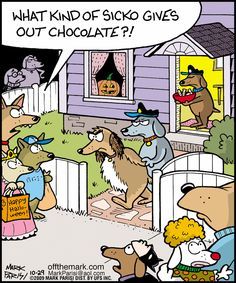
Cartoon of the Day: Dog Trick or Treat

 Check out this post about Dogs and Chocolate!


DOGS, CHOCOLATE, and HALLOWEEN: A Deadly Combination

It's Halloween, and if you're like me, there is a lot of chocolate in your house right now. Now you might be wondering why I am highlighting my golden retrievers on a Chocolate Blog, but there's a good reason. I've posted before that chocolate is dangerous for dogs. I'm careful when I cook and bake with chocolate, because golden retrievers -- well, most dogs -- will eat anything that drops on the floor. I only bake with good dark chocolate and that's exactly what can make dogs sick or worse.

Hills Pet Company has a very good article on Chocolate and Dogs that I want to share. I'm also reposting a Chocolate and Dogs Question &Answer about Halloween Candy. It's all good information for Dog Owners (Guardians) who also happen to be Chocoholics. Be safe!

Is Chocolate Bad for Dogs?

Chocolate is poisonous to dogs; however, the hazard of chocolate to your dog depends on the chocolate type, the amount consumed and the dog's size. In large enough amounts, chocolate and cocoa products can kill your dog.

Why not chocolate?
  • The toxic component of chocolate is theobromine. Humans easily metabolize theobromine, but dogs process it much more slowly, allowing it to build up toxic levels in their system.
  • A large dog can consume more chocolate than a small dog before it suffers ill effects.
  • A small amount of chocolate will probably only give your dog an upset stomach with vomiting or diarrhea.
  • With large amounts, theobromine can produce muscle tremors, seizures, an irregular heartbeat, internal bleeding or a heart attack. The onset of theobromine poisoning is usually marked by severe hyperactivity.
A single piece of chocolate should not be a problem. A single piece doesn't contain a large enough theobromine dosage to harm your dog; however, if you have a small dog that has eaten a box of chocolates, you need to go to the veterinarian immediately.

Different chocolate types have different theobromine levels. Cocoa, cooking chocolate and dark chocolate contain the highest levels, while milk chocolate and white chocolate have the lowest. If you’re dealing with any quantity of dark or bitter chocolate, err on the side of caution. The high level of theobromine in dark chocolate means it takes only a very small amount to poison a dog. Less than an ounce of dark chocolate may be enough to poison a 44-pound dog.

The usual treatment for theobromine poisoning is to induce vomiting within two hours of ingestion. If you are worried that your dog may have eaten a large quantity of chocolate, call your veterinarian as soon as possible.

Of course, never consider chocolate as a reward.

And here's another article on Chocolate and Dogs and Halloween: 

It's a Q &A between Neenda Pellegrini and Dr. Sheppard Thorpe, an emergency veterinarian at Puget Sound Veterinary Referral Center in Tacoma about Halloween and Pets that appeared in the Seattle Times.  Read the entire article HERE.

Pet ingestion of Halloween treats can cause vomiting, diarrhea, hyperactivity, pancreatitis, heart arrhythmias, seizures, liver disease, kidney disease, gastrointestinal obstruction and even death.

Dangerous or even fatal chocolate toxicity is rare because knowledgeable owners usually get their chocolate-eating pets into the clinic within a few hours of ingestion. Once the pet arrives, we do what is called "decontamination" -- vomiting is induced and then activated charcoal is administered.

We also see pets with general vomiting and diarrhea from gastrointestinal upset after they've eaten candy, wrappers and holiday decorations. This can be very serious if the pet develops pancreatitis or if the pet becomes very dehydrated.

A quick and timely response makes the treatment much easier on your pet and your wallet.

Question: Why is chocolate dangerous? Is some chocolate -- dark or bittersweet chocolate -- worse than others, such as milk or white chocolate?

Answer: Chocolate contains an active ingredient called theobromine, which is toxic to pets. Theobromine is a stimulant that pets are more sensitive to than people and can cause hyperactivity, elevated heart rate, twitching and tremoring, vomiting and diarrhea and, worst of all, seizures.

Dark chocolate is more potent, having a higher concentration of theobromine, and, therefore, is more toxic. All chocolate (cakes or brownies, milk chocolate, white chocolate, chocolate syrup, cocoa powder) is considered "rich." Although not as serious as theobromine toxicity, foods with high sugar and fat contents can cause serious stomach and bowel problems. Decontamination and quick treatment is key.

Question: What harm can one little candy bar do?

Answer: It depends on the size of your pet, the presence of any underlying conditions and the amount of chocolate your pet has ingested.

A Hershey's Kiss is safe for a 70-pound Labrador retriever to eat but harmful to a 3-pound Chihuahua.

Another problem with "just one little treat" is that dogs can develop a liking to chocolate and soon may be climbing on the table to help themselves to that whole bowl of Halloween candy.

The power of the dog nose can also help them find that wrapped box of chocolates under the Christmas tree or hidden away for Valentine's Day. I know one Beagle who learned to open the pantry, and he loved to eat the brownie mix.

Question: What should I do if my pet accidentally eats chocolate? What symptoms should I watch for?

Answer: Call your regular veterinarian or local emergency/referral veterinary hospital for recommendations.

It helps to have the candy wrapper with the list of ingredients and percentage of cacao or cocoa in the product.

Monitor your pet for hyperactivity, elevated heart rate, vomiting/diarrhea, tremors, twitches and seizures although preventive treatment long before any of these symptoms is the best approach.

Check out www.veterinarypartner.com and look up chocolate toxicity. This website has an excellent chart comparing the number of ounces of chocolate a pet would need to ingest for toxicity. READ MORE HERE.  


Tuesday, October 31, 2017

Dogs, Chocolate, and Halloween: A Deadly Combination

It's Halloween, and if you're like me, there is a lot of chocolate in the house. Now you might be wondering why I am highlighting Topper, my golden retriever, on a Chocolate Blog, but there's a good reason. I've posted before that chocolate is dangerous for dogs. I'm careful when I cook and bake with chocolate, because golden retrievers -- well, most dogs -- will eat anything that drops on the floor. I only bake with good dark chocolate and that's exactly what can make Topper sick or worse.

Hills Pet Company has a very good article on Chocolate and Dogs that I want to share. I'm also reposting a Chocolate and Dogs Question &Answer about Halloween Candy. It's all good information for Dog Owners (Guardians) who also happen to be Chocoholics. Be safe!

Is Chocolate Bad for Dogs?

Chocolate is poisonous to dogs; however, the hazard of chocolate to your dog depends on the chocolate type, the amount consumed and the dog's size. In large enough amounts, chocolate and cocoa products can kill your dog.

Why not chocolate?
  • The toxic component of chocolate is theobromine. Humans easily metabolize theobromine, but dogs process it much more slowly, allowing it to build up toxic levels in their system.
  • A large dog can consume more chocolate than a small dog before it suffers ill effects.
  • A small amount of chocolate will probably only give your dog an upset stomach with vomiting or diarrhea.
  • With large amounts, theobromine can produce muscle tremors, seizures, an irregular heartbeat, internal bleeding or a heart attack. The onset of theobromine poisoning is usually marked by severe hyperactivity.
A single piece of chocolate should not be a problem. A single piece doesn't contain a large enough theobromine dosage to harm your dog; however, if you have a small dog that has eaten a box of chocolates, you need to go to the veterinarian immediately.

Different chocolate types have different theobromine levels. Cocoa, cooking chocolate and dark chocolate contain the highest levels, while milk chocolate and white chocolate have the lowest. If you’re dealing with any quantity of dark or bitter chocolate, err on the side of caution. The high level of theobromine in dark chocolate means it takes only a very small amount to poison a dog. Less than an ounce of dark chocolate may be enough to poison a 44-pound dog.

The usual treatment for theobromine poisoning is to induce vomiting within two hours of ingestion. If you are worried that your dog may have eaten a large quantity of chocolate, call your veterinarian as soon as possible.

Of course, never consider chocolate as a reward.

And here's another article on Chocolate and Dogs and Halloween: 

It's a Q &A between Neenda Pellegrini and Dr. Sheppard Thorpe, an emergency veterinarian at Puget Sound Veterinary Referral Center in Tacoma about Halloween and Pets that appeared in the Seattle Times.  Read the entire article HERE.

Pet ingestion of Halloween treats can cause vomiting, diarrhea, hyperactivity, pancreatitis, heart arrhythmias, seizures, liver disease, kidney disease, gastrointestinal obstruction and even death.

Dangerous or even fatal chocolate toxicity is rare because knowledgeable owners usually get their chocolate-eating pets into the clinic within a few hours of ingestion. Once the pet arrives, we do what is called "decontamination" -- vomiting is induced and then activated charcoal is administered.

We also see pets with general vomiting and diarrhea from gastrointestinal upset after they've eaten candy, wrappers and holiday decorations. This can be very serious if the pet develops pancreatitis or if the pet becomes very dehydrated.

A quick and timely response makes the treatment much easier on your pet and your wallet.

Question: Why is chocolate dangerous? Is some chocolate -- dark or bittersweet chocolate -- worse than others, such as milk or white chocolate?

Answer: Chocolate contains an active ingredient called theobromine, which is toxic to pets. Theobromine is a stimulant that pets are more sensitive to than people and can cause hyperactivity, elevated heart rate, twitching and tremoring, vomiting and diarrhea and, worst of all, seizures.

Dark chocolate is more potent, having a higher concentration of theobromine, and, therefore, is more toxic. All chocolate (cakes or brownies, milk chocolate, white chocolate, chocolate syrup, cocoa powder) is considered "rich." Although not as serious as theobromine toxicity, foods with high sugar and fat contents can cause serious stomach and bowel problems. Decontamination and quick treatment is key.

Question: What harm can one little candy bar do?

Answer: It depends on the size of your pet, the presence of any underlying conditions and the amount of chocolate your pet has ingested.

A Hershey's Kiss is safe for a 70-pound Labrador retriever to eat but harmful to a 3-pound Chihuahua.

Another problem with "just one little treat" is that dogs can develop a liking to chocolate and soon may be climbing on the table to help themselves to that whole bowl of Halloween candy.

The power of the dog nose can also help them find that wrapped box of chocolates under the Christmas tree or hidden away for Valentine's Day. I know one Beagle who learned to open the pantry, and he loved to eat the brownie mix.

Question: What should I do if my pet accidentally eats chocolate? What symptoms should I watch for?

Answer: Call your regular veterinarian or local emergency/referral veterinary hospital for recommendations.

It helps to have the candy wrapper with the list of ingredients and percentage of cacao or cocoa in the product.

Monitor your pet for hyperactivity, elevated heart rate, vomiting/diarrhea, tremors, twitches and seizures although preventive treatment long before any of these symptoms is the best approach.

Check out www.veterinarypartner.com and look up chocolate toxicity. This website has an excellent chart comparing the number of ounces of chocolate a pet would need to ingest for toxicity. READ MORE HERE.